
AI-Optimized Jewelry Listings for Every Sales Channel
Appath turns supplier product data, product photos and each channel’s requirements into jewelry listings worth reading: titles, bullets, descriptions, keyword coverage and attributes, each with a quality score and checked against the channel before you see it. Part of Appath AI, in every plan.
- Image-aware optimization
- Channel-ready content
- Quality scoring
- Attribute coverage
- Keyword diversity
Supplier data wasn’t built to sell
Supplier feeds often provide the minimum product information needed to identify an item — not the rich, search-ready content needed to compete across sales channels.
A jewelry product may arrive as 14k 8x10mm Earrings. But shoppers search for material, design, style, size, finish, gifting intent, and product-specific details.
Generic AI writing tools can create copy, but they often miss what the image shows, repeat weak keywords, ignore channel formatting rules, or generate content that does not reflect the actual product. Manual listing writing does not scale across thousands of SKUs, variations, suppliers, brands, and channels.
Appath AI Product Optimizer turns incomplete supplier data into structured, image-aware, channel-ready listing content.
From supplier feed to channel-ready listing content
Supplier data is often incomplete, abbreviated, or not written for ecommerce search. Appath AI Product Optimizer transforms that raw data into structured, channel-ready listing content for Amazon, Walmart, Shopify, eBay, and other sales channels.
Instead of writing every product manually, operators can review, score, refine, and publish optimized listings at catalog scale.
- Product titles
- Bullet points
- Descriptions
- Attribute-rich listing copy
- Channel-specific content variations
- Keyword coverage
- Image-grounded product details
- Listing quality scores
AI Product Optimizer in 3 Steps
Appath reviews supplier data, product attributes, product images, category context, and sales channel requirements.
AI Product Optimizer creates optimized titles, bullet points, descriptions, and listing copy tailored for Amazon, Walmart, Shopify, eBay, and other sales channels.
Each draft is scored across seven quality dimensions, then checked by the same channel check Appath runs on any push: Amazon’s whole schema, Walmart’s item spec and eBay’s item specifics. A draft a channel would refuse is shown refused, naming the field. You publish through the listing preview; the Optimizer never publishes.
Not a standalone description generator
Appath AI Product Optimizer is connected to your catalog, product data, images, channel requirements, validation rules, and listing quality scores. That connection is what lets it do real work — not generate generic copy from a blank prompt.
Use real product attributes instead of generic prompts
Incorporate visible product details from images
Create channel-specific listing variations
Score output before approval
Highlight weak listings that need review
Improve content consistency across large catalogs
AI is most valuable when it works inside the operational workflow — not outside it.
7 dimensions of listing quality
Every listing is evaluated across the dimensions that influence search visibility, listing quality, and sales channel readiness. Each dimension is independent, transparent, and improvable.
Lead-with-keyword construction, attribute ordering, length within channel limits, brand and material in optimal positions for sales channel search.
Distribution of high-value search terms across the listing without keyword stuffing. Penalizes repetition; rewards range.
Each bullet has a distinct role (material, design, size, styling, gifting), opens with a strong attribute, and earns its character count.
Attributes visible in the product image are surfaced in the copy. Color, finish, design details, and proportions detected from the image flow into title, bullets, and description.
All sourceable attributes (metal, karat, size, weight, finish, gemstone, dimensions) are present and correctly placed.
Title length within Amazon/Walmart/eBay/Shopify constraints. Bullet character counts within sales channel limits. Description structure matches what each channel renders best.
Structured product descriptions that cover material, design, sizing, styling, and gifting context — written in prose that channels render well and that reinforces the keywords carried through the title and bullets.
The overall score is a weighted average. A score above 90 is strong. A score below 70 means the listing has a clear weakness; the scorecard tells you which dimension to improve.
From basic supplier data to optimized listing content
SKU E9B07. A real jewelry product as it arrives from the supplier, and the channel-ready content AI Product Optimizer produces from it.
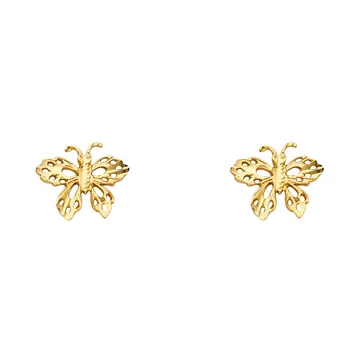
- SOLID 14K GOLD — Crafted from genuine solid 14K yellow gold, these butterfly stud earrings offer lasting fine-jewelry appeal in a lightweight everyday pair for women’s and men’s jewelry collections.
- OPEN BUTTERFLY SHAPE — The butterfly stud earrings feature an open design with cutout wings, curved antennae, and diamond-cut style detailing that adds bright texture and a graceful look.
- COMFORTABLE SIZE — With an 8 mm length and 10 mm width profile, these butterfly earrings offer a visible yet easy-to-wear scale for daily styling, giving you delicate character without an overly large look. Approx. 8×10 mm.
- EASY TO STYLE — The warm yellow gold tone and airy butterfly outline pair easily with casual outfits, dressier looks, and layered jewelry styling for both women’s and men’s accessories.
- GIFT BOX READY — These solid 14K yellow gold earrings arrive in a gift box, making them a thoughtful present for birthdays, holidays, anniversaries, or everyday gifting occasions.
Made from genuine solid 14K yellow gold, these butterfly earrings showcase an open design with diamond-cut style detailing across the wings. The butterfly shape is defined by cutout sections, a sculpted center body, and softly curved antennae that give the pair a lively, recognizable profile. At 8 millimeters in length and 10 millimeters in width, these gold studs combine the charm of butterfly earrings with the clean look of earring studs sized for frequent wear.
The open butterfly styling creates a lighter visual effect, while the diamond-cut style finish adds texture and brightness when the earrings catch the light. Their 8 × 10 millimeter size works well for everyday use, whether worn with casual clothing, office attire, or occasion looks that call for a subtle nature-inspired accent. These solid 14K yellow gold stud earrings suit women's and men's jewelry wardrobes alike and offer an easy balance of detail and wearability.
Each pair ships in a gift box, making a ready-to-give option simple for birthdays, holidays, anniversaries, and other celebrations.
Measured on real jewelry catalogs
These figures were measured on real multichannel jewelry catalogs: large supplier catalogs, their channel listing requirements, and the Optimizer’s own quality validation.
Priced in Appath AI credits, quoted before anything runs
The AI Product Optimizer is part of every plan and runs on the same credit balance as the rest of Appath AI. A job’s price is set by how many products it covers and how many channels it writes for. You see the quote in credits, and the job runs only when you confirm it.
Most catalog jobs are larger than a month’s allowance, so they are paid from a credit pack at your plan’s price per credit: 10¢ on Solo, 9¢ on Core, 8.5¢ on Growth and 7.5¢ on Scale. A job that fails, or one you cancel before it starts, returns its credits.
Example: 5,000 rings for Amazon and Walmart is 5,990 + 2,990 = 8,980 credits. Catalogs over 100,000 products are quoted with you. See plans and credit packs.
| Products in the job | First channel | Each further channel |
|---|---|---|
| Up to 1,000 | 2,990 credits | +1,490 |
| Up to 5,000 | 5,990 credits | +2,990 |
| Up to 10,000 | 9,990 credits | +4,990 |
| Up to 25,000 | 19,990 credits | +9,990 |
| Up to 50,000 | 34,990 credits | +17,990 |
| Up to 100,000 | 69,990 credits | +29,990 |
Capabilities that work with AI Product Optimizer
Frequently asked questions
Common questions about how AI Product Optimizer turns supplier product data into channel-ready listing content. If your situation isn’t covered, get in touch.
What is the Appath AI Product Optimizer?
Is the Optimizer included in my plan?
How do credits work for an Optimizer job?
What kind of product data can the Optimizer use?
Does it create different content for each sales channel?
Does the Optimizer publish to my channels?
What does the listing quality score measure?
Is the Optimizer only for jewelry?
Optimize Your Jewelry Catalog With AI
Turn supplier product data into channel-ready listings, scored for quality and checked against each channel, as part of Appath AI in every plan.